
Summoner's Vault TCG Rules
GAME OVERVIEW
Summoner's Vault is a tactical, turn-based Trading Card Game (TCG) where players assume the role of powerful Summoners commanding creatures, casting spells, and activating magical relics to control the battlefield. Each player begins the game with a Life Point total of 20–60, depending on their preference or the type of gameplay. Creatures are placed on the 3x3 grid, acting as blockers, protecting the Summoner from taking damage. Players build 60-card decks using region-specific and neutral cards, battling to reduce their opponent's Life Points to zero.
CARD TYPES
Creature – Units used to attack, defend, and hold battlefield positions.
Spell – One-time effects that create creature or Summoner buffs.
Talisman – Artifacts that alter game rules and buffs.
Relic – Ancient items with powerful effects on the field.
Summoner – The player's core character card; each deck includes one.
Altar – Energy sources for Bond Cost.
BATTLEFIELD STRUCTURE
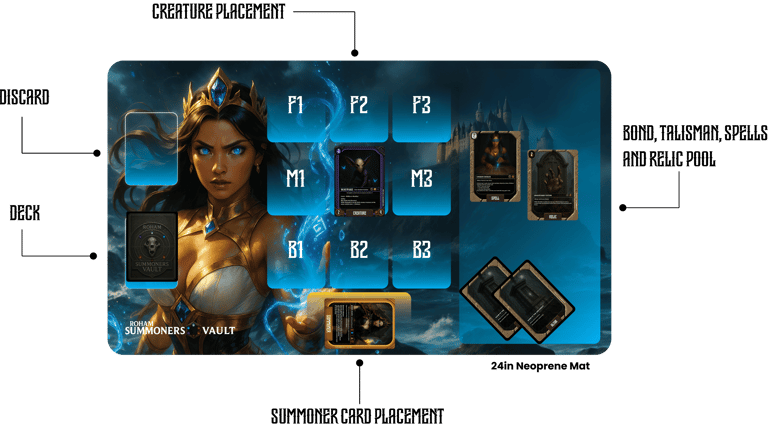
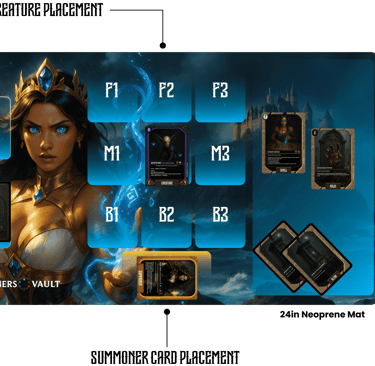
Each player controls their own 3x3 grid (3 rows x 3 columns per player).
Behind each player's grid is 1 Summoner Core Zone where their Summoner card is placed.
Creatures are the only cards placed on the grid unless attaching Relics, Talisman, or Spell cards for buffs.
Altars are placed in the Bond Pool Zone designated to the right of the Grid.
Cards on the grid cannot be moved once placed, unless specified otherwise.
DECK CONSTRUCTION RULES
Deck Size: 40–60 cards (minimum 1 Summoner, 10 Creatures)
Altar Cards: No limit (must fit within deck size)
Duplicate Limit: Max 3 copies per card (except Altars)
Region Affinity: Cards should generally align with the Summoner’s region affinity or be neutral. However, decks may also include cards that share an affinity with one of the Summoner’s dual-affinity Altar cards.
GAME SETUP
Each player places their Summoner in the Summoner Core Zone (bottom center).
Shuffle your deck and draw 7 cards.
Determine who goes first randomly.
Each player may mulligan once (shuffle and redraw 7).
TURN PHASES Each turn consists of:
Start Phase: Refresh all exhausted cards, resolve any start-of-turn effects, and draw 1 card.
Bond Phase: Play 1 Bond Source card (such as an Altar) into your Bond Pool Zone.
Summon Phase: Summon creatures or activate Relics, Talismans, or Spells by exhausting Bond Sources equal to their Bond Cost.
Main Phase: Play cards, activate abilities, and perform attacks.
End Phase: Resolve any end-of-turn effects, discard down to hand limit if applicable, and pass turn to opponent.
At the end of each turn, if a player has more than 10 cards in hand, they must discard down to the hand limit of 10.
BOND SYSTEM
Instead of a traditional mana system, players use the Bond mechanic.
Bonds are generated by playing Altar cards into your Bond Pool Zone.
Bonds are required to pay Bond Costs by exhausting Altar cards.
Bonds are color-specific and can only be used to pay for cards that share the same region affinity unless the card is Neutral.
Cards are not placed face-down as Bonds unless specified by a Trap or other card effect, but these are not considered Bond Sources.
PLAYING CARDS
Pay the Bond Cost by tapping that number of Bonds.
Place the card on the battlefield if applicable (Creatures, Altars, Relics, Talismans).
Spells, Relics, and Talismans are sent to the discard pile during End Phase unless marked Permanent or stated otherwise.
CREATURE PLACEMENT RULES
Frontline (Row 1): Only Beasts and Winged creatures can be placed here.
Midline (Row 2): Only Casters, Stalkers, or Winged creatures can be placed here.
Backline (Row 3): Only Titans, Casters, or Winged creatures can be placed here.
Winged creatures may be placed in any row regardless of role.
ATTACKING & COMBAT
Creatures can only attack enemies directly in the same lane (column), starting with the closest unit in that lane.
Attacks resolve in front-to-back order: damage is dealt to the frontline creature first. If the frontline is destroyed, no remaining damage is dealt to Midline or Backline unless specified by buff or abilities.
Midline creatures cannot be damaged unless the frontline in that lane is empty. Similarly, backline creatures cannot be damaged unless both the frontline and midline are empty.
Some abilities or Spells may allow for ranged, diagonal, or area attacks that bypass this order.
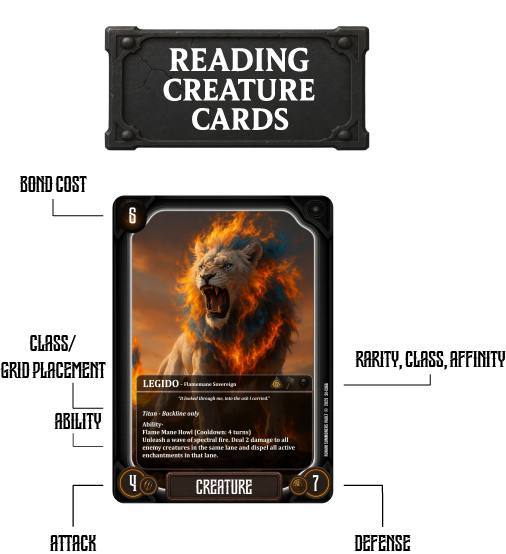
Damage is dealt based on the attacking creature’s Attack stat.
If a creature’s Life reaches zero, it is destroyed.
If no creature is present in the same lane, damage is dealt directly to the opponent’s Summoner.
SPELLS, RELICS AND TALISMANS
These card types offer tactical support, buffs, or temporary effects to enhance your strategy.
Spells are typically played during your Summon or Main Phase and provide one-time buffs or effects.
Relics are field-based items that enhance your creatures, modify battlefield conditions, or provide conditional benefits.
Talismans are artifacts that influence game rules, apply lingering buffs, or set up traps and conditions.
Unless marked Permanent or stated otherwise, these cards are discarded during the End Phase after their effects resolve.
VICTORY CONDITION
Reduce your opponent’s Life Points to 0.
A player also loses if they run out of cards in their deck and have no creatures on the battlefield.
NOTES
Summoners cannot be attacked directly unless their lane is empty or unless the card calls for it.
Cards with ongoing effects must remain face-up in the grid.
Decks must follow the regional affinity of their Summoner, or match one of their dual-affinity Altar cards.
Hand limit is 10 cards; players must discard down to this number during End Phase if exceeded.
Bonds are created by playing Altar cards and must match the region affinity of the card being played (unless Neutral).
Spells, Relics, and Talismans are discarded during End Phase unless marked Permanent or stated otherwise.
Cards cannot be moved on the grid once placed unless specified by abilities or effects.
Explore
Dive into the world of Summoner's Vault.
Connect
© 2025. All rights reserved.
Youtube/ SummonersVaultTCG
Discord/ SummonersVaultTCG